IP Transfer from the Academic Community
Greater transparency, fair terms, and efficient processes for research-based spin-offs
The transfer of intellectual property (IP) from universities and research institutions is a key prerequisite for successful science-based spin-offs. For technology-oriented startups in particular, patents, software, and know-how often form the basis of the business model.
However, the transfer or licensing of these rights presents challenges: Conflicting interests, legal requirements, and a lack of comparative data on standard market contract terms can complicate negotiations. In addition, startup teams often have less experience and market information than professional technology transfer offices.
Knowing what is customary in the market
Greater transparency, early communication, and reliable procedures can make IP transfer fairer, more efficient, and more conducive to startup growth.
Since 2018: Working Together to Improve IP Transfer
The Federal Ministry for Economic Affairs and Energy (BMWE) and the Federal Ministry for Research, Technology, and Space (BMFTR) have been working intensively since 2018 to address the framework conditions for IP transfer in scientific spin-offs. In joint stakeholder dialogues with universities, research institutions, startup teams, investors, and technology transfer organizations, challenges were analyzed and practical solutions were developed.
This has resulted in numerous practical resources, including specialized legal information, sample contracts, procedural guidelines, and practical examples. They are available at the exist IP Toolbox available.
The “Forschungstransfer” funding program has also introduced binding milestones to ensure early clarification and contractual regulation of IP transfer. Experience with the program shows significant progress in collaboration between startup teams and research institutions. Further action is needed, particularly with regard to the transparency and comparability of contractual terms. An overview of IP transfer at exist is provided by the exist Fact Sheet IP.
IP.Deals – Greater Market Transparency in IP Transfers
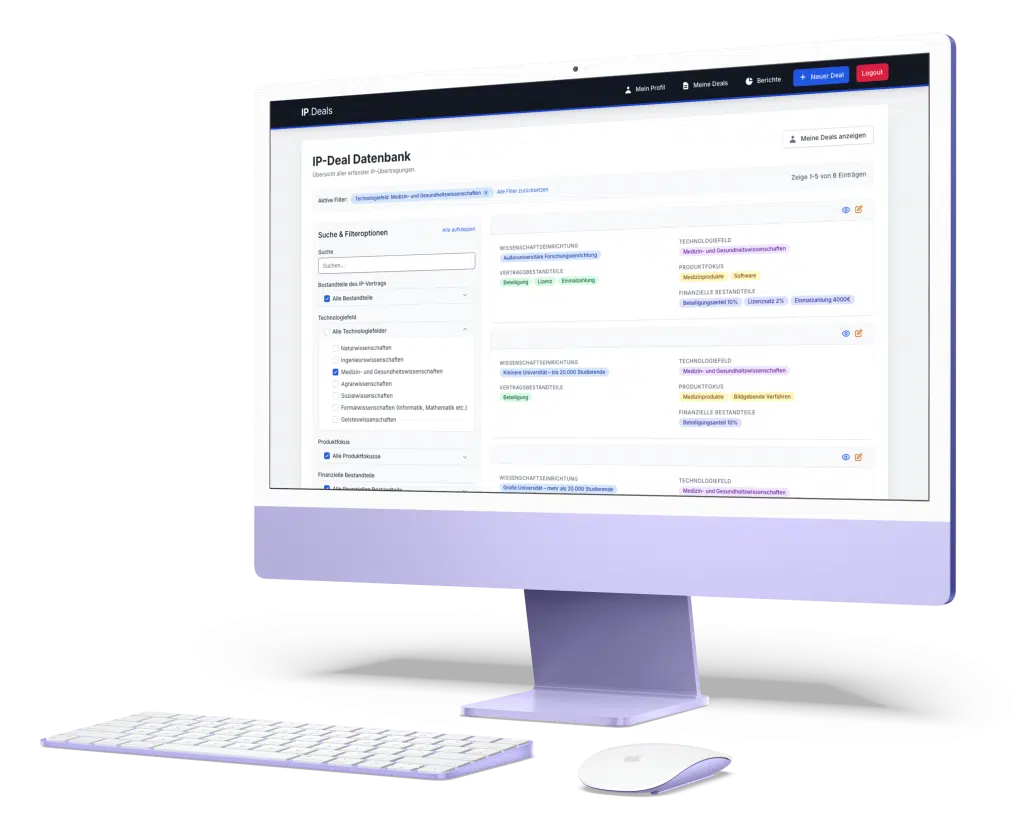
Comparative data instead of assumptions: The IP-Deal database provides a better foundation for fair and well-informed negotiations.
What are the typical licensing fees for comparable technologies? What types of purchase, licensing, or equity models are typically agreed upon? How do the terms vary across different technology fields?
So far, these questions have often been difficult to answer. IP agreements are negotiated on a case-by-case basis, and their terms are usually kept confidential. As a result, startup teams, technology transfer offices, and investors lack reliable benchmarks for comparison.
This is exactly where the IP Deal Database IP.Deals to.
A Shared Database for Technology Transfer
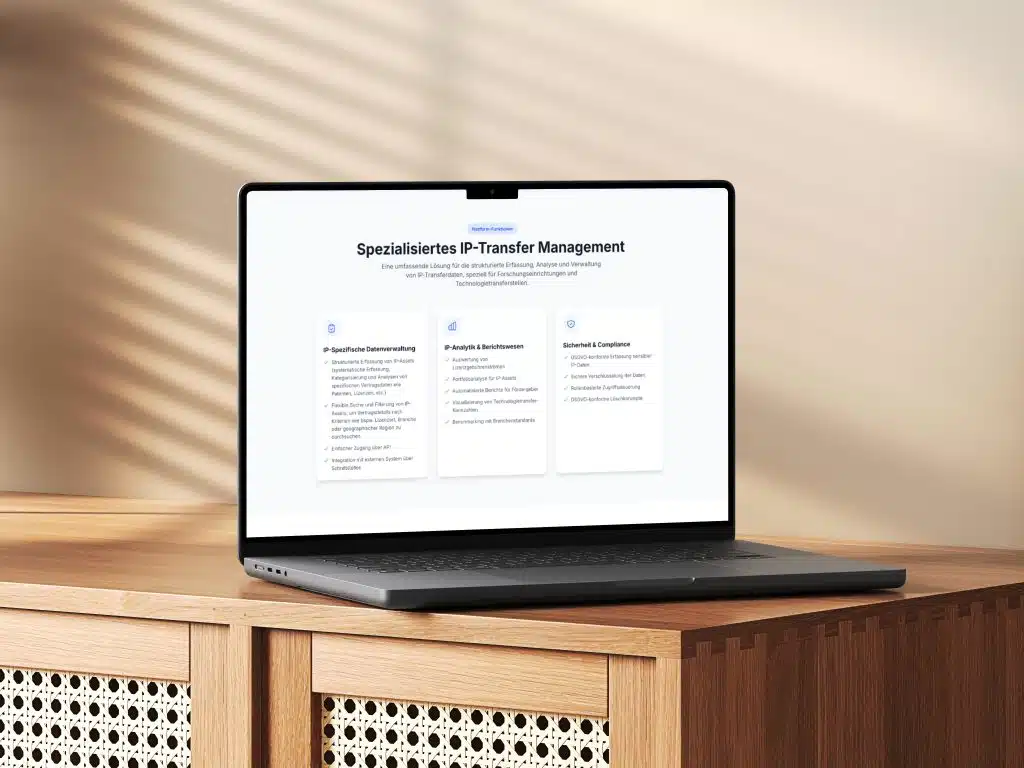
IP.Deals provides anonymized information from actual IP transfer agreements. The database offers insights into various contract models and terms, including those related to the transfer of patents, software, and know-how.
The following are included, for example:
- Type of Intellectual Property Transferred and Contractual Terms
- License Fees, Purchase Prices, and Equity Models
- Payment Terms and Other Financial Conditions
- Selected Characteristics of the Transfer Process
The available data can be filtered and analyzed according to various criteria to better classify comparable agreements.

Find your way, get personalized solutions
IP.Deals does not prescribe uniform contract terms. Each IP transfer is shaped by its own unique technological, economic, and legal circumstances.
However, the comparative data helps users better assess room for negotiation, evaluate different contract models, and develop realistic expectations. In this way, IP.Deals supplements existing model contracts and process guides with an empirical foundation that has been largely lacking until now.

A Joint Project for Greater Transparency
The IP-Deal database was developed under the leadership of the Technical University of Berlin in collaboration with TransferAllianz and funded by the BMWE as part of the exist funding program.
The platform is online and open to various user groups. Aggregated analyses are accessible without registration. Depending on their role, registered users receive further insights into the recorded IP deals. The confidentiality of the contracting parties is ensured through anonymized data collection and tiered access rights.

Get Involved and Improve Market Transparency
The value of the database grows with the number and variety of contracts entered. For this reason, transfer offices at universities and research institutions, in particular, are invited to enter completed IP deals and expand the shared database.
Data is entered using a structured input form. An AI-powered tool for the automated processing of contract information is currently under development or being tested and is expected to reduce the effort required for data entry in the future.
The more institutions participate, the more meaningful the comparative data becomes—and the greater the collective benefit for scientific technology transfer.
IP Toolbox: Information and Practical Resources
In addition to the IP Deal database, exist provides practical resources for managing IP transfer. These resources are intended for startup teams, universities, research institutions, and technology transfer offices.
IP.Deals: Benchmark Data for Fair IP Contracts

Legal Framework
Technical information and background materials on the legal requirements for IP transfer, particularly regarding issues related to higher education law, budgetary law, and state aid law, as well as the admissibility of standardized licensing models.

Process Guides
The guide, developed jointly by TransferAllianz and the Startup Association, outlines a structured negotiation process from the initial discussion to the IP agreement. Supplementary information explains the requirements of the “exist Forschungstransfer” funding program.

Sample Contracts and Contract Templates
Annotated sample contracts for IP purchase and licensing agreements, as well as information on various investment models, including virtual investments as an alternative to direct equity investments.

Practical Examples and Experiences
Examples from universities and research institutions illustrate different approaches to contract drafting, participation, and the valuation of intellectual property.

Additional Information
Supplementary technical materials and references to other standard contract documents—particularly those from the German Standards Setting Institute (GESSI)—provide additional guidance.
Some of the documents originate from previous professional events and working groups. These documents also serve to provide professional context and historical documentation. The currently applicable legal framework always takes precedence.