
exist Startup Grant

Here's how the funding works
With the exist startup grant, you’ll have twelve months to turn an idea into a viable startup. During the funding period, you’ll work together on your product, business model, and market entry. You’ll be supported by your university or research institution as well as the relevant startup network. In addition, you must meet a few milestones and obligations during the funding period. The goal is to guide your startup project step by step toward market readiness and the launch of your company.
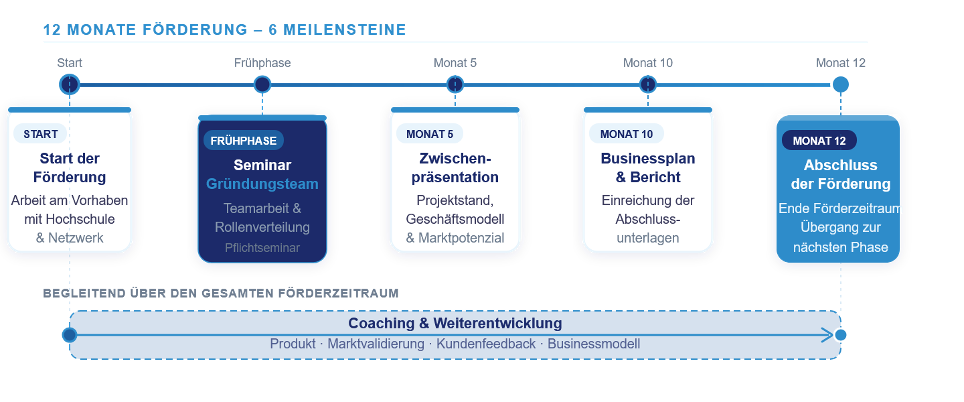
Important steps during the funding period
ESF Participant Questionnaire of the European Social Fund (ESF)
The exist Startup Grant is co-financed by the European Social Fund Plus (ESF Plus). For this reason, certain information regarding the recipients and projects must be collected.
The corresponding participant questionnaire is a mandatory component of the grant and is used for reporting and evaluating the programs to the European Union.
The information will be treated confidentially and used solely for the purposes of the funding and evaluation processes.
Support for the development of your startup
In addition to financial support for living expenses, the exist startup grant also provides funding for in-kind resources and coaching services.
These include, for example:
- Software and technical equipment
- Material costs for prototypes
- Licenses and Development Tools
- Market research
- Travel expenses
- External consulting and coaching services
- Design, communication, or development services
Planned expenses are prepared in advance as part of the application in collaboration with the university or research institution, documented throughout the project, and reimbursed as a lump sum. No more lists of receipts or individual approvals.
„Startup Team“ Seminar — Growing Together as a Team
The mandatory „Startup Team“ seminar is designed to help you strengthen teamwork early on and clearly define roles and expectations.
Among other things, the focus is on:
- Team Dynamics and Communication
- Role Understanding and Responsibilities
- Conflict Management
- Decision-making processes
- shared goal
Especially in the early stages of a startup, a well-functioning team is a key factor for success.
Interim Presentation - Feedback for the Next Steps
An interim presentation will take place around the midpoint of the funding period. During this presentation, you will present the current status of your startup project to the startup network at the university or research institution.
Typical topics include:
- Product or technology development
- Business Model
- Understanding the Market and Target Audience
- Customer feedback
- Progress on the project
- next steps in development
The interim presentation provides an opportunity to receive valuable feedback for the startup's future development.
Final project documents
At the end of the grant period, please submit the following documents:
- a business plan
- An evaluation of the startup network
- a report on the results
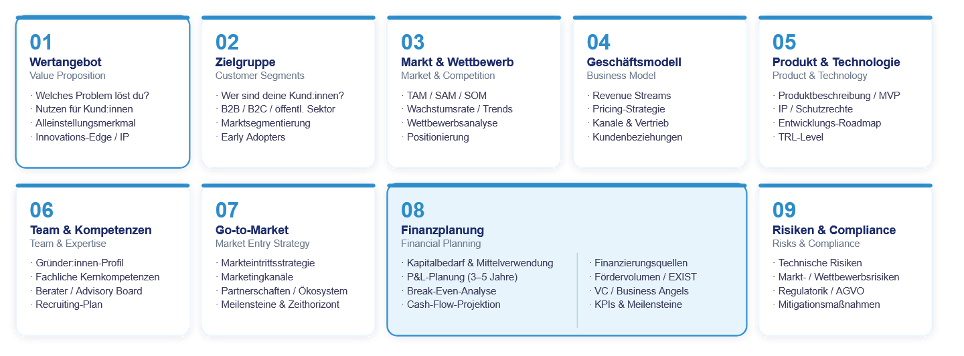
The Business Plan outlines how your startup is expected to develop financially. In particular, it describes:
The Evaluation of the Startup Network evaluates the business plan from a technical perspective. She provides feedback on the content, quality, and maturity of the project.
The Earnings Report documents the progress of your project during the funding period. It shows what progress has been made and what the next steps are.
The financial statements serve as an important basis for potential follow-on financing and for the company’s future development.
New Procurement Regulations
What will change for grant recipients?
New regulations have been in effect since July 1, 2026, giving grant recipients greater flexibility in awarding contracts (BAnz AT June 18, 2026, B3, and BAnz AT June 18, 2026, B4). This is subject to the condition that, based on their grant award notice or their entitlement to the grant, they are required to apply the UVgO or—for certain construction services—the VOB/A. In addition, BAnz AT June 18, 2026, B4 introduced a new provision to facilitate the awarding of contracts to Startups have been published. Since this can easily lead to confusion, we'd like to break down the new regulations for you.
What does BAnz AT 18.06.2026 B3 say about grant recipients?
BAnz AT 18.06.2026 B3 addresses streamlined procedures for grant recipients (for example, in the case of an existing funded project) regarding the conduct of negotiated awards.
In a negotiated procurement process, suitable companies are invited to submit a proposal or to participate in negotiations. The proposals may then be negotiated. As a general rule, at least three suitable companies should be involved.
With the publication of the new regulation in the Federal Gazette, grant recipients now have the following options:
- Up to 100,000 euros net: A negotiated award without a competitive bidding process is possible. In this case, there is no prior public bidding process. Instead, suitable companies are invited directly to submit a bid or enter into negotiations.
- Up to the respective EU threshold: A negotiated award with a competitive bidding process is possible. In this process, companies can first apply publicly to participate. Selected companies are then invited to submit a bid or enter into negotiations.
- Up to the respective EU threshold: Alternatively, a negotiated award with prior publication may be conducted. In this case, the planned award is publicly announced before bids are solicited or negotiations are conducted.
No additional specific requirements under Section 8(4) of the UVgO need to be met to use these award methods. The appropriate type of procedure may be selected within the specified value limits.
Important: One Negotiated Award Without a Call for Bids This is not a direct award. A procurement process will still take place, and the remaining provisions of the UVgO must be complied with. BAnz AT 18.06.2026 B3 does not introduce any new regulations for direct awards!
The value threshold for direct awards therefore remains unchanged at 15,000 euros net, as specified in the notice published in the BAnz on December 29, 2025, under reference B1.
These regulations have been in effect since July 1, 2026, and will cease to be in effect as soon as a new version of the UVgO is published.
Source: BAnz AT June 18, 2026, B3
What does BAnz AT 18.06.2026 B4 say?
Additional simplifications apply when a contract is awarded to a startup. These are intended to make it easier for young companies to access public contracts.
Important: The special provision does not mean that startups are allowed to award contracts more easily simply because they are startups. The award of contracts is favored to a startup.
This regulation may be applied by federal contracting authorities as well as—pursuant to Section IV—by grant recipients who are required by grant law to apply the UVgO or the VOB/A.
A contract worth up to 100,000 euros (net) may be awarded directly to a startup if:
- the project involves an innovative solution,
- the selected startup has been in existence for no more than four years at the time the contract is signed, and
- the other size and ownership limits are met.
If the grant recipient is itself a startup, that is not sufficient for the provision to apply. The key factor is that the company awarded the contract meets the requirements.
Source: BAnz AT June 18, 2026, B4
Project Completion
The transition to the next phase
The end of the funding period doesn't mark the end of your startup's development; in fact, this is often when the next critical phase of growth begins.
Many teams:
- start their business during or after receiving funding
- develop the first market-ready products
- attract pilot customers
- establish contacts with investors and secure follow-on financing
- transition to advanced programs or incubators
The exist startup grant lays the groundwork for this.
- Earnings Report
- Supporting documentation for expenses and supplies
- any additional project-related documents
Your university or research institution will assist you in properly completing the project.
It is also important to keep all relevant original documents in accordance with the guidelines.
What funding options are available after the exist startup grant?
After receiving the exist startup grant, there are various paths available to you for further developing and financing your startup. The best option for you depends on your business model, stage of development, capital requirements, and upcoming milestones.
Examples of follow-on financing include:
- exist Research Transfer
- Funding programs from the federal government, state governments, and the EU
- KfW Subsidized Loans
- Business Angels
- Venture capital and seed investors
- Accelerators and incubators
- strategic partnerships with companies
- Contests, Prize Money, and Awards
- Bootstrapping or revenue-based financing
With the exist grant, a viable business plan, and initial market validation, you’ll lay a strong foundation for discussions with investors, funding agencies, and strategic partners. It’s important to plan follow-on financing early on and tailor it specifically to the next stage of development.